Biotechpharmamarketing.com
Building Topical Authority on a New Biotech & Pharma Marketing Website
Read Full Case Study βThe life science market is highly competitive, with suppliers offering hundreds of thousands of products ranging from routine laboratory consumables to highly specialised scientific instruments and innovative technologies. Standing out requires more than a single marketing channelβit requires a coordinated lead generation system that keeps your products visible wherever researchers and scientific buyers search for solutions. While established companies often invest heavily in paid advertising, trade publications and industry events, smaller and innovative businesses can compete effectively through SEO, content marketing, targeted email campaigns, account-based marketing and carefully targeted LinkedIn advertising.
Different products also require different commercial approaches. Routine laboratory equipment and consumables often have shorter purchasing cycles, whereas novel technologies and advanced scientific instruments require educational marketing that explains new applications, demonstrates scientific value and builds awareness long before a purchasing decision is made. By combining multiple marketing channels, we help life science and nanotechnology companies generate awareness, educate prospective customers and create a sustainable pipeline of qualified leads. We help you to promote your laboratory automation equipment, scientific reagents and consumables including antibodies, ELISA kits, genomics, proteomics, clinical diagnostics reagents, microscopes, software, laboratory equipment including PCR machines, sequencing instruments, imaging devices to scientists, researchers, laboratory managers, principal investigators, procurement specialists in academia, pharma, biotech, hospitals, routine testing, industrial laboratories as well as to distributors.
Generating qualified leads in the life science industry requires a different marketing approach than in many other B2B sectors. Companies compete in crowded markets while communicating complex scientific value to researchers, laboratories and technical buyers.
β Scientific proof drives purchasing decisions β Peer-reviewed publications, application notes, citations and validated use cases strongly influence product adoption. Innovative products with limited published evidence require educational marketing to build scientific credibility and awareness.
β Researchers are not aware about your innovation β Scientists often search for solutions they already know rather than technologies they have never encountered. Introducing new applications, workflows or measurement capabilities therefore requires proactive content marketing, conferences, email campaigns and targeted advertising rather than relying solely on search demand.
β The best technology is not always the most visible β Superior products do not automatically become market leaders. Companies that consistently invest in marketing, scientific communications and industry visibility are often discovered first, while equally capable or even better technologies remain overlooked.
β Established purchasing processes favour existing suppliers β Many laboratories order through approved distributors, procurement systems or preferred suppliers. Introducing a new product often requires creating awareness among researchers first before procurement teams consider adding another supplier or product to their purchasing workflow.
β Thousands of competing products β Researchers can choose from thousands of reagents, laboratory instruments, consumables and software solutions. Standing out requires clear positioning and continuous visibility across multiple marketing channels.
β Large product portfolios are difficult to market β Many life science companies offer hundreds or thousands of products, making it impractical to optimise every product page or application area. Prioritising the right products, applications and customer segments is essential for achieving measurable marketing results.
Scientists rarely purchase after seeing a single advertisement. They typically discover products through Google, scientific publications, colleagues, conferences, distributors and technical content before contacting suppliers. Effective lead generation therefore requires multiple marketing touchpoints that build awareness and trust throughout the buying process. Rather than relying on a single marketing channel, successful life science companies combine SEO, content marketing, scientific communications, email marketing, paid advertising and digital PR to remain visible wherever prospective customers search for information. This integrated approach not only generates qualified leads but also strengthens scientific credibility and long-term brand recognition.
Nanotechnology products often address several industries simultaneously, including life sciences, semiconductors, materials science, energy and advanced manufacturing. This creates unique marketing challenges because each audience searches using different terminology, solves different problems and follows different buying criteria. Successful lead generation therefore requires careful audience segmentation, industry-specific messaging and marketing campaigns tailored to each application area.
In the life sciences, nanotechnology is often physics applied to biology. While engineers and physicists may understand the underlying technology, researchers are typically interested in the biological questions it can answer or the experiments it enables. As a result, life scientists may never search for the technical solution itself because they are unaware such capabilities exist. This makes educational marketing, targeted email campaigns, account-based marketing and carefully targeted advertising particularly valuable for introducing innovative technologies to niche scientific audiences and creating demand before active product searches begin.
Medical technology companies often operate in highly specialized markets where purchasing decisions involve multiple stakeholders, including clinicians, procurement teams, distributors, hospital administrators and regulatory specialists. Whether selling medical devices, diagnostic instruments, digital health solutions or surgical technologies, successful lead generation requires identifying the right decision-makers and tailoring marketing messages to the specific clinical, technical and commercial needs of each audience. Educational content, product demonstrations and application-focused messaging are essential for communicating value beyond technical specifications.
Unlike many B2C healthcare products, MedTech sales cycles are typically long and involve careful evaluation, clinical validation and budget approval before purchasing decisions are made. Effective lead generation therefore combines SEO, targeted email campaigns, LinkedIn advertising, account-based marketing and conference marketing to build awareness among prospective customers long before they actively begin supplier evaluations. By consistently educating decision-makers across multiple channels, MedTech companies can strengthen their market presence and generate qualified sales opportunities. Here you can learn more about our content marketing services for MedTech companies.
Clinical diagnostics companies serve diverse customer groups, including hospitals, diagnostic laboratories, research institutions, healthcare providers and pharmaceutical companies. Each segment has different testing requirements, purchasing criteria and regulatory considerations, making audience segmentation and tailored marketing campaigns essential for successful lead generation. Whether promoting molecular diagnostics, pathology solutions, laboratory automation or diagnostic assays, companies must clearly communicate clinical applications, workflow improvements and scientific evidence that supports product adoption.
The diagnostics market is driven by scientific credibility, laboratory performance and trust rather than impulse purchasing. Potential customers often spend considerable time comparing technologies, evaluating validation data and reviewing application-specific information before engaging with suppliers. As a result, lead generation strategies should combine SEO, educational content, targeted email marketing, LinkedIn campaigns and account-based marketing to reach laboratory managers, clinicians, procurement teams and industry partners throughout their buying journey, creating visibility and demand before formal purchasing processes begin.
Every successful lead generation programme starts with a clear marketing strategy and implementation plan. We evaluate your product portfolio, target applications, customer segments, distribution model and current marketing activities to identify the channels most likely to generate qualified leads. Whether you sell laboratory equipment, reagents, consumables, analytical software or research services, we help prioritise products, define target audiences and create a practical marketing roadmap aligned with your commercial objectives and available budget. The result is a structured plan that guides future marketing investments and provides a clear path for sustainable growth.
Scientific buyers expect evidence-based information before considering a new product or supplier. We create technical and marketing content that explains your products, demonstrates their applications and builds scientific credibility throughout the buying journey. This includes website copy, SEO articles, application notes, protocols, case studies, white papers, brochures, product comparison pages, conference materials, webinar presentations and other scientific communications that help researchers understand the value of your technology and choose it with confidence.
Researchers increasingly discover laboratory products through Google, AI-powered search and scientific databases before contacting suppliers or distributors. We optimise product pages, category pages, application pages, protocols, FAQs and other technical content to improve discoverability for relevant scientific searches. Our SEO services for nanotech and life science companies include keyword research, search intent analysis, on-page, technical and off-page SEO, content optimisation, and continuous performance monitoring. We also optimise content for AI search (GEO/AEO), helping your products appear in AI-generated answers and other emerging discovery platforms where researchers increasingly seek scientific information.
Effective lead generation and business development start with identifying the right audience. We build target prospect lists by identifying relevant companies and decision-makers, researching verified business contact details, and organising contacts into structured marketing databases or CRM systems. We then segment audiences based on industry, company type, job function, research area, products, services and other relevant criteria to ensure every campaign reaches the most appropriate prospects in academia and industry in life sciences. Well-segmented databases enable more personalised email marketing, account-based marketing (ABM), paid advertising and lead nurturing campaigns. Unlike broad marketing campaigns, account-based marketing focuses on carefully selected high-value target accounts that match your ideal customer profile. We also support trigger-based marketing by identifying prospects based on company or industry events, allowing timely and highly relevant outreach. This level of targeting improves engagement, increases response and conversion rates, and generates more qualified sales opportunities. Learn more about our scientific intelligence and data processing capabilities.
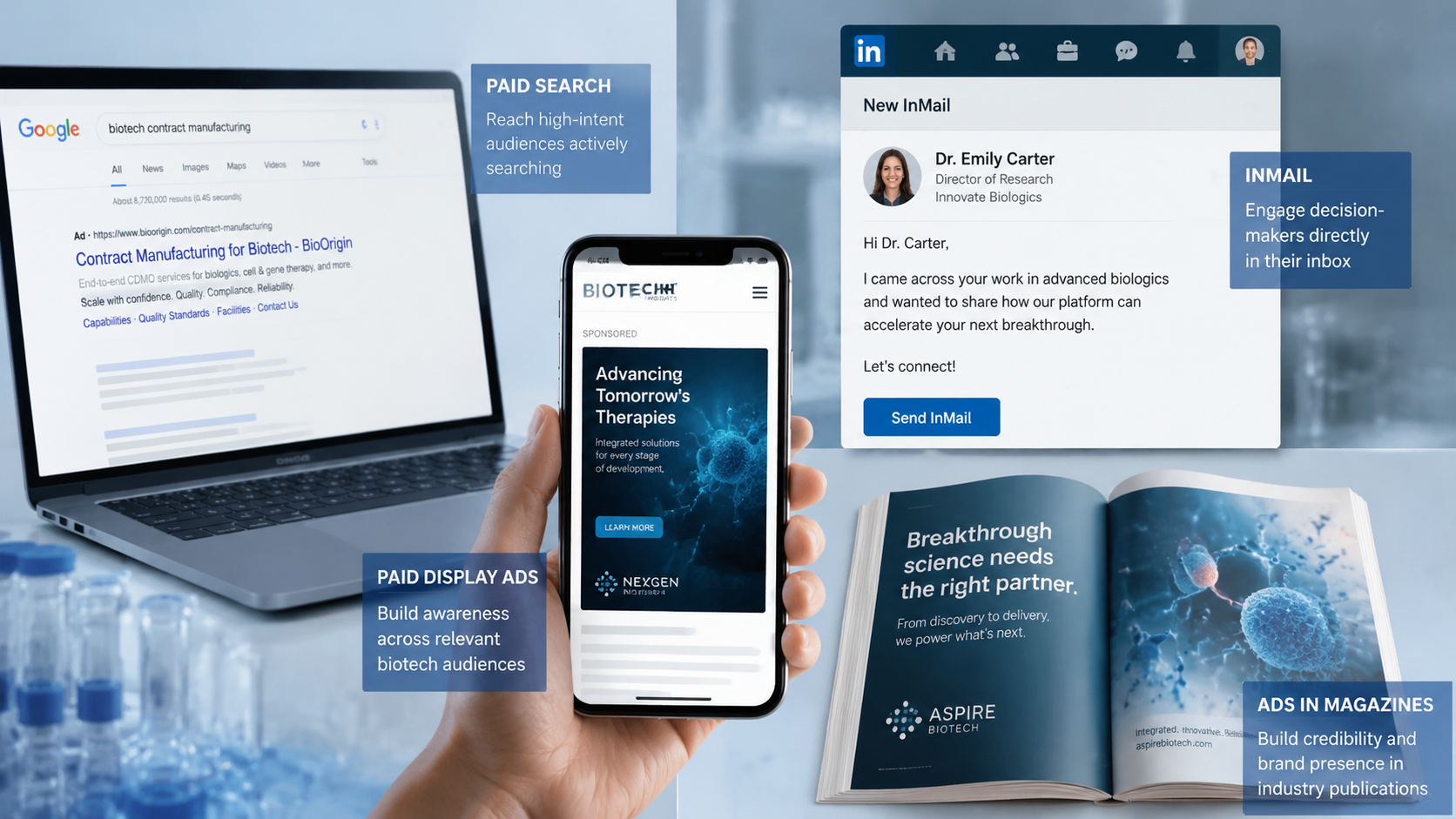
Paid advertising helps life science companies quickly increase visibility among researchers, laboratory professionals and scientific buyers. We manage search and display campaigns across Google Ads, LinkedIn Ads, ResearchGate, LabX, scientific magazines, newsletter sponsorships and other industry-specific platforms to promote products, webinars, publications and product launches. Campaigns can target broad scientific audiences or highly specific customer segments using account-based marketing principles. We also implement remarketing campaigns to re-engage previous website visitors and maximise the value of your existing marketing traffic.
Email marketing remains one of the most effective channels for reaching researchers, laboratory managers and scientific buyers with relevant and timely information. We develop compliant email campaigns to promote product launches, newly published applications, scientific publications, webinars, conference participation, educational content and other updates that keep your company visible throughout the customer journey. We also create segmented lead nurturing campaigns tailored to different research areas, technologies and customer groups, helping prospects discover new products, applications and capabilities as their research evolves. Combined with SEO, content marketing and paid advertising, email marketing creates multiple touchpoints that strengthen awareness and generate qualified leads over time.
Scientific credibility plays a central role in the adoption of life science products. Researchers are more likely to trust technologies supported by peer-reviewed publications, application notes, case studies, citations and validated scientific evidence than products promoted through advertising alone. We help strengthen your company's authority through scientific communications, press releases, industry publications, digital PR, backlinks, collaborations, scientific directories and other activities that increase visibility and trust. These efforts improve discoverability across search engines and AI platforms while creating additional opportunities for researchers and scientific buyers to discover your products.
Scientific conferences, trade shows and industry exhibitions remain valuable opportunities to introduce products, meet researchers and generate qualified leads. We support event marketing through pre-event email campaigns, attendee outreach, landing pages, paid advertising, webinar promotion and post-event lead nurturing to maximise visibility before, during and after the event. We can also assist with conference brochures, scientific posters, presentations, application notes and other marketing materials that help communicate the value of your products to prospective customers. By combining digital marketing with in-person events, companies can extend the impact of conference participation beyond the exhibition floor and generate more opportunities from each event.
Effective lead generation is an ongoing process of testing, measurement and continuous improvement. We monitor website traffic, search rankings, advertising performance, email engagement, lead quality and conversion metrics to identify opportunities for optimisation and sustainable growth. Each marketing channel contributes differently to the customer journey, with SEO, content marketing, paid advertising, email marketing and digital PR reinforcing one another to build awareness, trust and qualified sales opportunities. While multi-touch attribution is rarely straightforward in B2B life science and nanotechnology marketing, we analyse user behaviour, campaign performance and traffic trends to understand what is working, optimise marketing spend and continuously improve campaign effectiveness.
Building Topical Authority on a New Biotech & Pharma Marketing Website
Read Full Case Study β
SEO & Technical Optimization for XP Pharma Consulting: From Zero Visibility to Multi-Query Rankings
Read Full Case Study β
Content Marketing & LinkedIn Strategy for BCA Advanced Therapies: Building Thought Leadership and Targeted Connections
Read Full Case Study β
Email Marketing Campaign for BCA Advanced Therapies: Targeted Lead Generation for LRS Chambers
Read Full Case Study βUnlike general marketing agencies, Deepli specialises in science-driven industries. We have experience promoting laboratory equipment, nanotechnology, biotechnology, life science and medtech products and services for more than 100 organisations, helping clients increase product visibility, generate qualified leads and support scientific product launches and commercial growth. We understand that successful life science marketing requires more than simply increasing website traffic. Researchers discover products through search engines, scientific publications, conferences, distributors, technical documentation and recommendations from colleagues. That is why we combine marketing strategy, SEO, scientific communications, email marketing, paid advertising and digital PR into an integrated lead generation system that keeps your products visible throughout the scientific buying journey.
We also recognise that different products require different commercial approaches. Routine laboratory consumables may benefit from targeted outbound campaigns and distributor support, while highly innovative instruments and technologies often require educational content, scientific validation and long-term awareness building before demand is created. Rather than applying the same formula to every client, we recommend the marketing mix that best fits your products, target audience and commercial objectives.
You definitely have questions about lead generation. Check FAQs and if you still have questions or want to start campaigns get in touch with us below.